Diabetes Journey™
Clinical DSMES — ADCES 7 Self-Care Behaviors
"The road map guides your journey when the path gets harder."
The Diabetes Journey™ is a trauma-informed, culturally responsive clinical diabetes self-management education and support (DSMES) program aligned with the ADCES 7 Self-Care Behaviors. It is the clinical layer of the Re-IX5 ecosystem — the program that receives community prevention participants who have or are at risk for Type 2 diabetes, and delivers the clinical depth that LIFE Journey is designed to prepare them for.
Diabetes does not develop because people lack willpower or information. It develops within systems that were never built to support health. The Diabetes Journey is built to meet people where that reality has landed them — without shame, without judgment, and with the full clinical and relational infrastructure needed to move forward.
Seven chapters. One continuous journey.
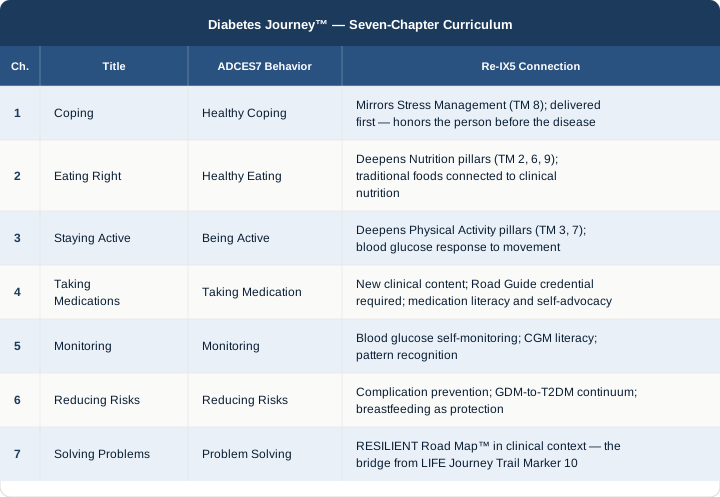
The Diabetes Journey is organized across seven chapters, each aligned with one of the ADCES 7 Self-Care Behaviors. It is delivered by credentialed Road Guides — Certified Diabetes Care and Education Specialists (CDCES), registered dietitians, or clinically trained community health workers. The program qualifies for G0108 (individual) and G0109 (group) DSMES billing codes when delivered by a credentialed Road Guide.
Chapter 1 — Coping — is delivered first by design. Travelers who arrive with diabetes distress, shame around their diagnosis, or fear of complications cannot engage meaningfully with clinical content until the emotional environment is addressed. Beginning with coping honors the person before addressing the disease.
Chapter 7 — Solving Problems — brings the RESILIENT Road Map™ into the clinical context. The same 7-step framework introduced at LIFE Journey Trail Marker 10 is applied here to clinical self-management challenges — giving Travelers a shared language that moves seamlessly between community sessions and clinical encounters
Who the Diabetes Journey™ serves
The program is designed for four population groups, each with adapted emphasis:
• Adults with established T2DM — full seven-chapter curriculum; G0108/G0109 billing eligible; medication literacy included
• Adults with prediabetes — behavior change emphasis over clinical management; chapters 1, 2, 3, and 7 as primary content
• Individuals with GDM history (postnatal) — all seven chapters; Chapter 6 (Reducing Risks) explicitly addresses the GDM-to-T2DM continuum and breastfeeding as protection
• Family members of individuals with T2DM — Community Mode delivery; Chapter 7 applied to family health goals rather than personal diabetes management
The program is supported by the Road Check Card system — a structured clinical documentation tool aligned with IHS workflow requirements — and twenty clinical support documents (T-1 through T-20) providing session-by-session guidance, assessment instruments, and referral documentation tools.
Where the Diabetes Journey™ fits in the ecosystem
The Diabetes Journey is the clinical continuation of community prevention work already done:
• Travelers from LIFE Journey™ are referred at Trail Marker 10 through a documented referral pathway, arriving with behavioral foundations, problem-solving confidence, and family support infrastructure already established
• S.A.F.E. Journey™ graduates with GDM history are referred through a postnatal referral pathway, given the 50–60% lifetime T2DM risk associated with GDM
• The RESILIENT Road Map™ is the structural bridge between both community programs and the Diabetes Journey — the same tool, the same language, the same seven steps, in two different delivery contexts
ADCES DEAP accreditation is in progress. Recognition as an accredited DSMES program creates a sustainable reimbursement pathway independent of grant funding.
Interested in the Diabetes Journey™ for your clinical program, IHS unit, CAH, Rural Health Clinic, or FQHC?